
What are coating systems?
Coating systems are technical systems used to apply materials as defined layers onto substrates. Depending on the application, material system, and objective, their design, process control, and degree of automation vary significantly. While simple systems enable individual coating steps, modern coating systems are designed to map processes holistically and control them reproducibly.
In industrial and research environments, it's not just about applying a layer, but about the controlled interplay of mechanics, material supply, substrate guidance and process parameters. Only this combination allows layer properties to be specifically adjusted and results to be reliably evaluated.
Technical systems for structured process development
Coating systems are technical systems that enable the controlled application of materials as defined layers onto substrates. Their purpose is not merely to apply a layer, but to... manageable implementation of a coating process under reproducible conditions. Coating systems combine mechanical precision, defined motion sequences, and controlled process management in a coordinated overall system.
In practice, coating systems primarily serve to streamline processes. to develop, compare and stabilize systematically. By selectively adjusting relevant parameters – such as substrate guidance, coating application, or process speed – material systems can be systematically investigated and further developed. Modern coating systems thus create the basis for reliable results that extend beyond individual experiments and can be used in the long term.
Coating systems in research, development and industry
Coating systems are used wherever functional layers need to be specifically produced and tested. In research and development, flexibility, accessibility, and comparability are paramount. Processes are frequently adapted, varied, and systematically investigated. In industrial applications, however, process stability, repeatability, and scalability take center stage. Here, coating systems must operate reliably over extended periods and meet defined quality requirements.
Modern laboratory and pilot plants form the interface between these two worlds. They allow processes to be developed first under controlled conditions and then scaled up – without fundamental process disruption.
The challenges include:
Coating systems in research
Flexible systems for the targeted investigation of material and process parameters
In research, coating systems primarily serve to investigate new material systems and coating concepts under controlled conditions. Flexibility and accessibility are paramount, as process parameters are frequently adjusted and varied. Coating systems make it possible to selectively modify individual influencing factors and systematically analyze their effects on coating quality, morphology, or function. Reproducible conditions are crucial for obtaining reliable and comparable measurement results.
Coating systems under development
Structured plant concepts for stabilizing and securing processes
During the development phase, the focus shifts from pure investigation to... structuring process formation. Coating systems are used to gradually stabilize processes, define process windows, and establish reproducible procedures. The goal is to develop a robust coating process from individual trials, one that is resilient to fluctuations. Development-oriented coating systems often bridge the gap between laboratory and application-oriented implementation and are therefore designed with precision and modularity.
Coating systems in industrial applications
Reproducible coating processes for application-oriented and scaled systems
In industrial applications, coating systems must deliver consistently stable results over extended periods. Repeatability, process reliability, and scalability are paramount. These systems are designed to maintain defined process parameters consistently over long periods and reliably meet quality requirements. Industrial coating systems typically build upon previously developed and validated processes, adapting them to a near-application or near-series production context.
Why precise coating systems are crucial
Basis for reproducible processes, comparable results and stable layer quality
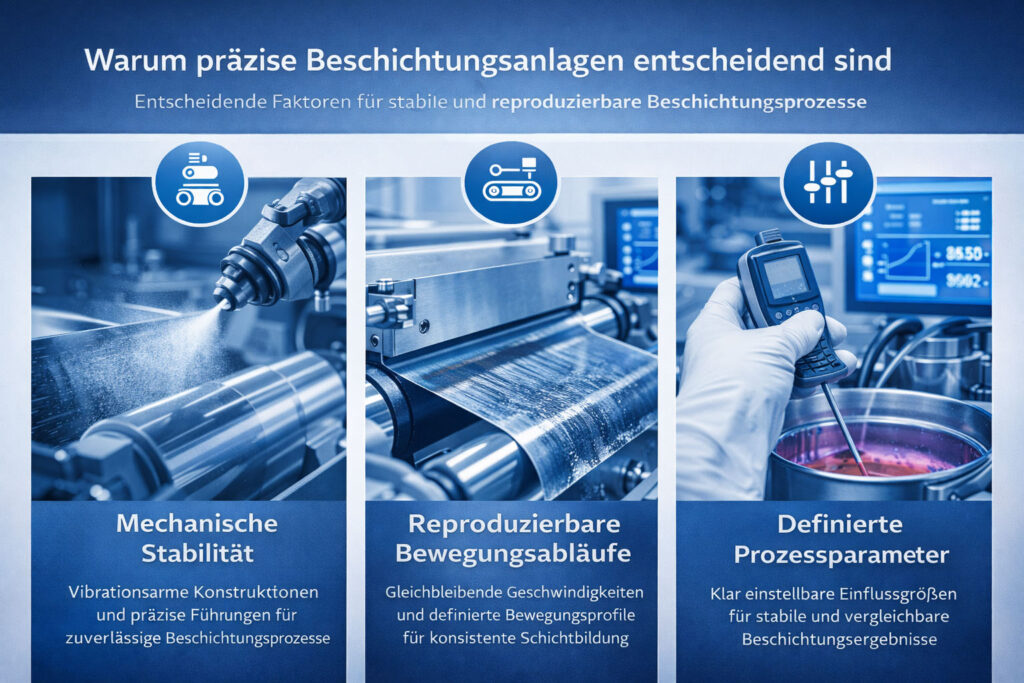
Torsionally rigid constructions and precise guides ensure that substrates and coating units reliably maintain their position.
Precision coating systems form the basis for reproducible and reliable coating processes. Regardless of the method used, the quality of the system determines whether process parameters can be maintained stably and coating properties reliably set. Mechanical accuracy, controlled motion sequences, and defined references are crucial for minimizing variations and systematically developing processes. Especially in development and application-oriented environments, precise coating systems enable the transition from individual trials to stable, comparable processes.
Overview of common coating processes in coating plants
Coating systems can implement various processes that differ significantly depending on the material system, substrate type, and process objective. The selection of the appropriate coating process largely determines how precisely layers can be applied, how stable the processes are, and how well results can be reproduced.
In practice, processes are therefore not considered in isolation, but rather used within the context of a comprehensive process concept. Common coating processes range from batch approaches for research and development to continuous processes for application-oriented or scaled-up applications. Some processes allow for particularly flexible parameterization and are suitable for the systematic investigation of material systems, while others are designed for uniform layer formation and high process stability. Modern coating systems are designed to accommodate different processes or to replicate them comparably in order to provide structured support for development and optimization processes.
Sheet-to-sheet coating
Sheet-to-sheet coating involves coating individual substrates discontinuously. This process is particularly suitable for development and research processes where specific parameters need to be varied and evaluated. The individual handling of each substrate allows for high flexibility and precise process control.
Roll to Roll Coating
Roll-to-roll coating is a continuous process in which flexible substrates are coated from roll to roll. It is frequently used when processing large quantities of material or when scaling processes. Stable web guidance and constant process parameters are crucial.
Slot Die Coating
Slot die coating is a pre-metered wet coating process that enables particularly uniform coatings. It is suitable for precision applications with high demands on coating thickness and homogeneity and is frequently used in combination with continuous or batch systems.
Doctor Blade Coating
Doctor Blade Coating is an established method for development and laboratory processes. It allows for easy and flexible adjustment of the layer thickness and is frequently used to quickly evaluate material systems and investigate process windows.
Wet coating process
Many coating systems utilize wet chemical processes. In wet coating, a liquid or paste-like material is applied to the substrate and then dried or further processed. The controlled formation of the wet film is a key success factor here.
Perovskite coating
describes coating processes in which Perovskite-based materials They are applied as a functional layer onto a substrate. Due to the high sensitivity of these material systems, precise process control is necessary to produce uniform and reproducible layers with defined properties.
Coating systems from Coatinggap – structured, precise, application-oriented.
Coatinggap pursues a consistently process-oriented approach in the development of coating systems. The focus is not on individual processes, but rather manageable, reproducible coating processes. Systems are designed in such a way that key influencing factors can be clearly defined, specifically adjusted and kept stable.
Modular concepts allow for the mapping and comparison of different processes. This makes it possible to develop processes step by step, to systematically evaluate them, and to continue them in a targeted manner – from the first laboratory experiment to application-oriented piloting.
System solutions for manageable coating processes
Coatinggap's coating systems are consistently developed from a process perspective. The focus is not on a single coating process, but rather on the ability to clearly structure processes, manage them reproducibly, and develop them further in a targeted manner. Each system is designed so that all relevant influencing factors can be precisely defined, kept stable, and varied in a traceable way.
Coatinggap places particular emphasis on mechanical precision, robust designs, and clearly referenced motion sequences. These qualities form the basis for coating processes that not only function but can also be understood, compared, and reliably ensured in the long term. Modular concepts allow for the integration of diverse processes and requirements without altering the fundamental structure of the system.
Coating systems as a basis for sustainable process development
Coating systems are more than just technical tools – they form the basis for stable, reproducible and long-term controllable coating processes. Only when systems are structured and all relevant influencing factors can be controlled can processes be reliably developed, compared, and refined. Especially in demanding applications, this technical foundation determines whether individual experiments lead to robust processes.
A holistically conceived plant concept enables a systematic understanding and targeted optimization of coating processes. Mechanical precision, defined process parameters, and a clear process logic create the foundation for sustainable development – from early material analysis to application-oriented or scalable solutions. Coating systems thus become a key component for quality, efficiency, and process reliability.
Select coating systems strategically and use them sustainably
Basis for reproducible processes, comparable results and stable layer quality
The selection of a suitable coating system is crucial in determining the long-term stability, reproducibility, and scalability of a coating process. Besides the process itself, mechanical precision, clear references, and structured process control play a central role. Coating systems must be designed not only to meet current requirements but also to allow for future adaptations and further developments. Only on this basis can processes be operated consistently and reliably ensured across multiple development stages.
Coating plants as a strategic investment
Coating systems are long-term tools for process control. Their quality determines whether
Processes must remain reproducible, be further developed, and deliver reliable results. A structured plant design creates planning certainty and reduces development risks. Therefore, it is worthwhile not to consider coating systems in isolation, but as an integral component of a sustainable process strategy.
What matters in modern coating systems
Talk to us about your coating system
Describe your application, your requirements, and your objectives. We will support you in selecting, designing, and further developing suitable coating systems and will get back to you promptly with expert feedback. Together, we will determine how your coating processes can be set up to be stable, reproducible, and future-proof.