
Fundamentals of modern coating processes
Coating refers to the targeted application of liquid or paste-like materials to a substrate to create functional properties. Depending on the application, coatings can provide protective functions, electrical properties, barrier effects, or chemical functionality. In an industrial setting, this is not about individual coating trials, but rather about reproducible processes with clearly defined quality criteria.
A modern process requires precise coordination of all relevant parameters. These include, among other things, the material properties, the coating speed, the coating distance, and the mechanical stability of the system. Even slight deviations can significantly affect the coating quality.
This type of coating is used in numerous industries, from thin-film coating and printed and flexible electronics to membrane coatings and energy applications. Crucially, the process should not be considered in isolation, but rather as part of a larger process chain. Only when coating is carried out under controlled conditions can results be reliably compared, optimized, and scaled.
Modern coating processes These processes are based on the controlled interplay of material properties, mechanical precision, and stable process control. The goal is to produce functional layers with a defined thickness, homogeneous structure, and reproducible quality. The decisive factor is not the individual coating process, but rather the ability to consistently control all process-relevant parameters.
Why coating is crucial
The quality of a coating significantly determines the function of the final product. Uncontrolled coating processes lead to coating defects, performance losses, or unstable results. Therefore, coating is not just a processing step, but a crucial quality factor in research and industry.
Typical challenges in the coating process
Layer thickness variations
Different layer thicknesses lead to local variations in functional properties.
unstable wet film formation
An unstable liquid film causes defects, inhomogeneities, and uneven layers.
Limited reproducibility
Identical settings will not produce comparable results if the process is not run stably.
Properly implemented coating under controlled conditions
Stable process parameters are the basis for homogeneous and reproducible coatings.
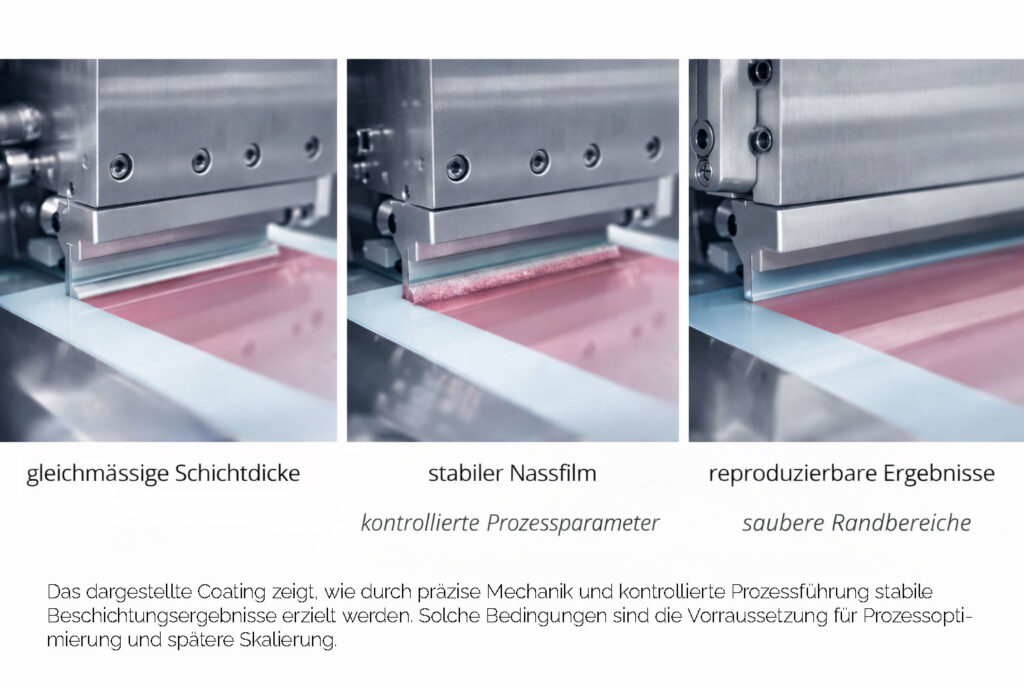
A correctly implemented coating process is characterized by a uniform wet film, stable process conditions, and controlled layer formation. The coating distance, material feed, and relative movement between the coating unit and the substrate are precisely coordinated.
The coating shown demonstrates how stable coating results can be achieved through precise mechanics and controlled process management. Such conditions are a prerequisite for comparability, process optimization, and subsequent scaling.
Stable process control is crucial, as functional layers only reliably develop their properties if layer thickness, homogeneity, and surface quality remain constant. The image illustrates how a controlled coating process enables reproducible results and lays the foundation for subsequent scaling.
Typical application areas in coating
This coating is used in a wide variety of technological and industrial applications where functional surfaces need to be precisely tailored. The goal is to produce layers with a defined thickness, homogeneous structure, and reproducible quality. Typical applications are found wherever surface properties significantly determine the function of a component or system.
Coating is of particular importance in the field of thin film coating, where even slight variations in layer thickness can affect functionality. It is also relevant in applications of... roll-to-roll coating The coating plays a central role, as continuous processes with flexible substrates require stable, uniform, and reproducible process control. Other application areas include printed and flexible electronics, membrane coatings, energy systems, and industrial functional coatings.
In all these areas, the process places high demands on process control, material handling and reproducibility, especially with sensitive materials or large-area substrates.
Thin-film coating
Thin-film applications require homogeneous layers with precisely defined thickness, as even small deviations can affect the function.
Printed & Flexible Electronics
Flexible substrates place high demands on process stability and uniform material distribution.
Perovskite coating
Sensitive material systems require stable process control and reproducible layer formation.
Fuel cell coating
Electrodes and functional layers must be coated with high precision and consistent quality.
Membrane coating and membrane casting
Layer thickness and homogeneity determine the separation properties and lifespan of membranes.
Industrial functional coatings
Coatings for the targeted manipulation of mechanical, chemical or electrical properties.
Why Coatinggap is excellent for coating
The process places high demands on the systems used and the underlying process control. The crucial factor is not merely that a coating is technically possible, but that it is effective. stable, reproducible and controllable This can be carried out. This is precisely where Coatinggap's approach comes in.
As experienced coating company Coatinggap pursues a consistently process-oriented approach to coating itself, focusing on mechanical precision and process stability. Instead of relying on complex or difficult-to-understand solutions, coating processes are designed so that all relevant parameters are clearly defined, adjustable, and reproducible. This creates transparency and enables a deep understanding of the relationships between material, process, and coating result.
A key advantage of coating gap systems lies in their mechanical stability. Uniform movements, precise distances, and controlled material feed ensure that coating processes are not affected by external influences or random fluctuations. This allows layer thicknesses, homogeneity, and surface quality to be reliably set and reproduced across multiple process runs.
Furthermore, Coatinggap enables processes to develop and continue systematically. Initial trials can be conducted under controlled conditions and subsequently optimized in a targeted manner. The insights gained can be systematically transferred to further process steps or larger scales without altering the fundamental process logic.
Coating is therefore not viewed as an isolated single step, but as manageable component of a higher-level process chain. This approach reduces development risks, increases the comparability of results, and creates a robust foundation for future applications. Coatinggap thus supports users in establishing stable, long-term coating processes and making technically sound decisions.
Development process and specific achievements
Coatinggap supports the entire coating development process – from initial feasibility studies to stable, reproducible coating processes. Precise and mechanically stable systems allow for the clear definition, targeted variation, and reliable evaluation of process parameters. This ensures that coating is not viewed as an isolated experiment, but rather as a structured development process with verifiable results.
Coatinggap enables the step-by-step optimization of coating processes, the systematic documentation of findings, and the controlled further development of processes. This creates a solid foundation for comparability, process understanding, and subsequent transfer to application-oriented or industrial environments.
Coating as a controlled quality factor
Coating is a key component of modern product development and industrial manufacturing. In many applications, the quality of the coating directly determines a product's function, performance, and lifespan. The coating process itself is not the only decisive factor; rather, it is the ability to control coating processes. stable, reproducible and scalable to design. Only if layer thickness, homogeneity and surface quality can be reliably controlled can results be compared, optimized and scaled up.
Coating processes stable, reproducible and scalable to design. Only if layer thickness, homogeneity and surface quality can be reliably controlled can results be compared, optimized and scaled up.
Coating therefore places high demands on process control, mechanics, and system stability. Uncontrolled or difficult-to-reproduce processes lead to fluctuations in coating quality and hinder targeted further development. Coatinggap provides the technical foundation for this by structuring and controlling coating processes from the outset. This transforms coating into a predictable and controlled quality factor, enabling sustainable development and reliable implementation in application-oriented or industrial processes.
make contact
We would be happy to assist you with the technical evaluation of your coating process and the selection of suitable coating solutions. Describe your application to us – we will get back to you promptly.
Use the contact form and briefly describe your requirements – we will get back to you promptly.