
What is industrial coating?
Industrial coating encompasses all coating processes used for the permanent use in industrial applications are designed for industrial use. Unlike purely experimental laboratory processes, industrial coatings must meet clearly defined quality criteria and be produced reproducibly under controlled conditions. Key characteristics of industrial coatings are:
Industrial coatings are used wherever functional layers are required to provide specific properties, such as electrical conductivity, barrier properties, mechanical protection, or chemical functionality. Typical applications include thin film coating, printed and flexible electronics, perovskite coating, fuel cell coating, and membrane manufacturing.
The selection of the appropriate coating process depends heavily on material properties, substrate type, layer requirements, and production goals. While simple processes such as doctor blade coating While often used for early development stages or basic feasibility studies, industrial applications require precisely controlled coating processes that are mechanically stable and process-technically manageable.
Why process control is crucial in industrial coating
In industrial coating, the coating quality is not determined by a single parameter, but by the interplay of mechanics, process control and material behavior. Fluctuations in gap heights, coating speed, or material dosage lead directly to coating defects, inhomogeneities, or unstable processes. Therefore, precise control of all relevant process parameters is essential for industrial applications. Only in this way can reproducible results be achieved, processes compared, and coatings reliably scaled.
The challenges include:
Layer thickness variations over large areas
Uneven process conditions lead to variations in layer thickness across the substrate surface and local deviations in functional properties.
unstable wet film formation
Unstable wet film formation occurs when the liquid film is not formed uniformly during coating and tends to develop defects or inhomogeneities.
Material losses due to uncontrolled dosing
Limited reproducibility means that identical process settings do not reliably lead to the same coating results.
Industrial coating under controlled conditions
A stable coating process as the basis for reproducible industrial quality.
The image shown depicts a correctly executed industrial coating, in which all process-relevant parameters are specifically coordinated. The coating takes place under stable, reproducible conditions, so that a uniform, homogeneous wet film forms over the entire substrate surface.
As specialized Coating Company The focus here is not on isolated machine parameters, but on the interplay of all process-relevant influencing factors. Only when mechanics, fluid flow, and process control are consistently coordinated can functional coatings be reliably produced under realistic industrial conditions. The result is stable processes that guarantee consistently high coating quality both during development and in subsequent application.
In industrial coating, this process stability is crucial, as functional layers only reliably fulfill their properties if thickness, homogeneity, and Surface quality are constant. The image illustrates how a well-managed coating process creates the basis for reproducible results and subsequent scaling.
Typical application areas in industrial coating
Industrial coatings are used in a wide variety of industries where functional layers specifically determine material properties. One key area is... thin film coating, in which homogeneous thin films with a defined function are produced, for example for optical, electronic or energy applications.
In printed and flexible electronics Industrial coating enables the reproducible coating of flexible substrates with conductive or functional materials. Also in the perovskite coating Research and development plays an important role in industrial coating, as sensitive material systems require stable process control.
Another focus is on fuel cell coating, in which electrodes, catalyst layers, or membrane layers must be coated with precisely defined properties. Industrial coating is also a key process in the Membrane coating and membrane casting, where layer thickness and homogeneity have a direct influence on function and service life.
Thin-film coating
Production of homogeneous thin films with defined functional properties for technical and electronic applications.
Printed & Flexible Electronics
Reproducible coating of flexible substrates with conductive, semiconducting or insulating materials.
Perovskite coating
Precise coating of sensitive material systems where layer uniformity and process stability are crucial.
Fuel cell coating
Coating of electrodes, catalyst layers and functional layers with precisely controlled layer thickness.
Membrane coating and membrane casting
Production of functional membranes with uniform structure and reproducible separation properties.
Sheet-to-sheet and roll-to-roll applications
Application of defined layers to selectively influence mechanical, chemical or electrical properties.
Why Coatinggap for industrial coating
Industrial coating places significantly higher demands on coating systems than purely experimental laboratory processes. In addition to the coating function itself, mechanical stability, reproducible parameter settings, and a clear understanding of the process are crucial. This is precisely where Coatinggap's approach comes in.
Coatinggap develops coating systems with a clear focus on Controllable and reproducible process control. Instead of complex black-box solutions The focus is on mechanical precision, transparent parameter settings, and stable process conditions. This allows for the systematic development, evaluation, and optimization of industrial coating processes.
A key advantage of coating gap systems is the ability to scale processes from the laboratory to near-production levels. without a fundamental process break to transfer. Processes such as slot die coating or sheet to sheet coating can be developed under defined conditions and later scaled without losing central process logics.
Furthermore, coating gap systems enable a structured combination of different coating processes. This allows for early material tests to be conducted using doctor blade coating and subsequently transitioned to more precise, pre-dosed processes. This approach reduces development risks and creates a robust foundation for industrial applications.
Industrial coating is therefore not understood as an isolated process, but as Part of a holistic process development, where quality, reproducibility and scalability are taken into account from the outset.
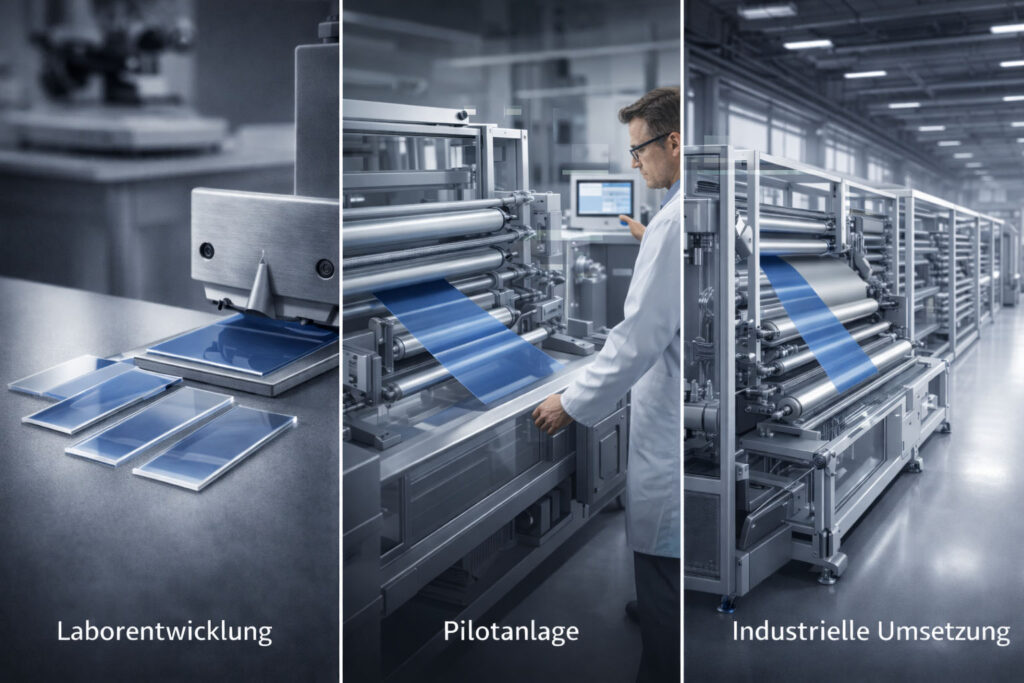
From development process to industrial implementation
The transition from initial laboratory experiments to industrial application represents one of the greatest challenges in industrial coating. Processes that work on a small scale cannot be automatically reproduced under near-production conditions. Often, altered geometries, higher process speeds, or different material quantities lead to deviations in Layer thickness, homogeneity or functionality.
A structured development process is therefore crucial. Coating processes must be developed in the laboratory under conditions that realistically reflect later scaling. This includes mechanically stable systems, clearly defined process parameters, and a reproducible interplay of material, movement, and dosage.
Systematically develop industrial coatings
Industrial coating requires a structured approach that goes far beyond simple coating trials. Crucially, processes must be developed from the outset under conditions that realistically reflect later industrial implementation. This includes mechanically stable systems, clearly defined parameters and a deep understanding of the relationships between material, process and result.
Coatinggap supports this approach with coating systems specifically designed for industrial requirements. Instead of creating short-term solutions, the focus is on sustainable process development, reproducible results, and a clear scaling strategy. This enables not only the implementation but also the long-term mastery of industrial coating processes.
The process thus becomes a plannable, controlled process – from the initial idea through process development to industrial application.
make contact
We would be happy to support you in the technical evaluation of your application, the selection of the appropriate coating process and the design of a reproducible industrial coating process.
Use the contact form and briefly describe your requirements – we will get back to you promptly.