
Slot die coating with precise gap control
Slot die coating is one of the most precise and reproducible coating processes for producing homogeneous thin films on rigid and flexible substrates.
It will be in wet coating Used in research, pilot production, and industrial process development – including for thin-film coatings, printed and flexible electronics, perovskite coatings, fuel cell coatings, and membrane coating and casting. At Coatinggap, we don't consider slot die coating a standard process, but rather a high-precision technology whose success depends significantly on one factor: the coating gap.
What is slot die coating?
Slot die coating is a pre-dosed coating process, in which a precisely defined amount of liquid is evenly distributed through a slot (slot die) onto a moving surface substrate is applied. The resulting wet and dry film thickness is essentially determined by:
Volume flow rate & coating speed
The Volume flow describes, how much coating fluid per time The slot is promoted.
Material and rheological properties
The Coating speed describes, how quickly the substrate under the slot die is moved.
The mechanical distance between slot die and substrate
The Rheology describes that Flow behavior of a liquid under mechanical stress.
Why the coating gap is crucial
Precise and stable slot: The coating gap control determines process reliability and coating quality.
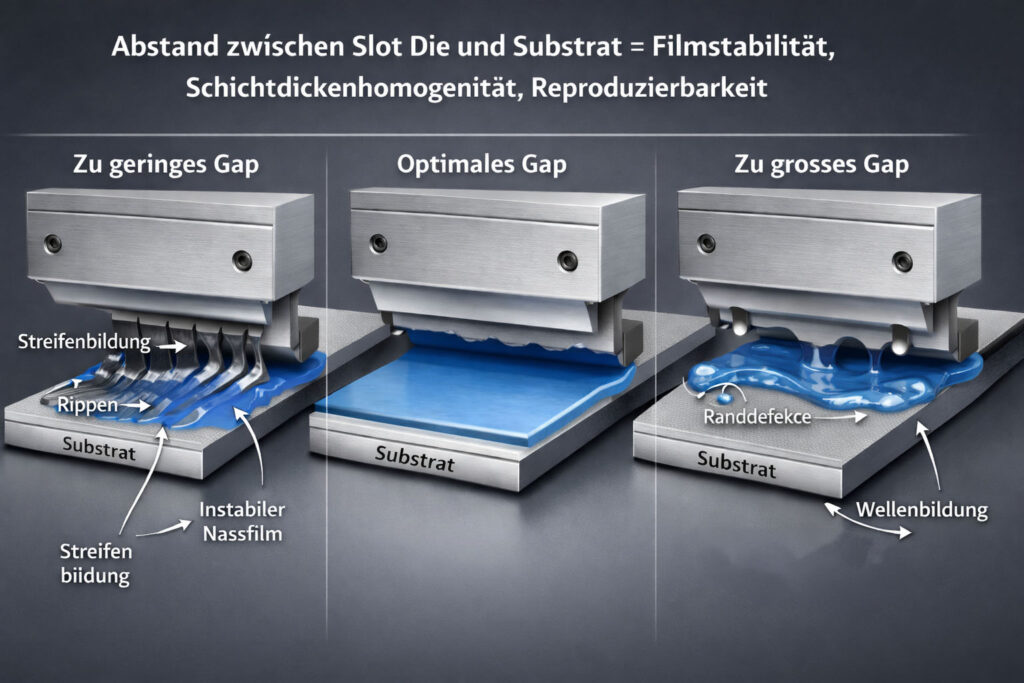
The Gap between slot die and substrate This is the most critical parameter in slot die coating. Even the slightest deviations in the micrometer range can lead to the following:
Especially in demanding applications such as Perovskite layers, Fuel cell electrodes or functional membranes decides a stable, precise gap setting about whether a process is controllable or not. Slot die coating is therefore less a question of fluid supply – but primarily a question of mechanical precision.
Whether process development, material evaluation, or lab-to-pilot scaling – we provide you with sound, application-oriented advice. Describe your coating challenge to us, and we will get back to you with a technically suitable solution.
Typical applications of slot die coatings
Slot die coating is used wherever precise, homogeneous and reproducible thin films are required. Thanks to the pre-metered material feed and controlled gap adjustment, the method is particularly suitable for demanding applications in research, development, and pilot production.
Slot die coating has established itself as one of the most important precision coating processes when it comes to producing homogeneous, reproducible thin films. This is achieved through pre-metered material feed, which controlled process management And the precise adjustment of the coating gap makes the process suitable for a wide variety of demanding applications in research, development and pilot production.
Especially where layer quality, material efficiency and process stability are crucial, slot die coating offers clear advantages over open or non-pre-dosed coating processes.
Thin-film coating
In the Thin-film coating Slot die coating is used to apply functional layers in the nm to µm range with high uniformity. Typical applications include optical functional layers, electronic layers, barrier coatings, and energy functional layers.
Printed & Flexible Electronics
In the Printed and Flexible Electronics Slot die coating plays a central role in the coating of flexible substrates with conductive, semiconducting, or insulating materials. Applications range from sensors and flexible conductor tracks to electronic functional layers on polymer films.
Perovskite coating
The Perovskite coating This places particularly high demands on process control. Perovskite materials are sensitive to variations in layer thickness, process instabilities, and uneven film formation.
Fuel cell coating
At Fuel cell coatings Functional layers such as electrodes, catalyst layers, or membrane layers with precisely defined properties are required. Layer thickness, homogeneity, and material distribution directly influence the efficiency, performance, and lifespan of the fuel cell.
Membrane coating and membrane casting
In the Membrane coating and membrane casting Slot die coating is used to produce polymer-based or functionalized membranes with defined thickness and structure. Applications include filtration, separation technology, energy storage, and medical technology.
Sheet-to-sheet and roll-to-roll applications
Slot die coating is used in both Sheet-to-sheet operation as well as in Roll-to-roll process usable. While sheet-to-sheet systems are particularly suitable for laboratory and pilot applications, roll-to-roll operation allows for scalable process control under near-production conditions.
Why use coating gap for slot die coating?
As specialized coating company Slot die coating places the highest demands on mechanical precision. Therefore, Coatinggap focuses not on standard solutions, but on a controlled and reproducible coating gap.
Our systems are designed for:
This makes it suitable Coating gap systems ideal for Process development, Material evaluation and Lab-to-pilot scaling.
From laboratory to pilot plant – without process interruption
A key advantage of slot die coating is its scalability. Coatinggap systems allow processes to be developed on a laboratory scale and later transferred to pilot processes., without changing the basic process logic.
What coating gap systems enable
Coatinggap systems are designed to not only technically implement precise coating processes, but also controllable, reproducible and scalable to do this. The focus is not on a single machine function, but on the interplay of all process-relevant parameters – with a special focus on the stable and precisely adjustable coating gap.
Precise and reproducible slot die coating gap setting
One of the key strengths of coating gap systems is the µm-accurate setting and reproducibility of the coating distance between the slot die and the substrate. This distance is the most critical mechanical parameter in slot die coating and directly influences film stability, layer thickness homogeneity, and process reliability. A mechanically rigid design and finely adjustable positioning units allow for reliable repetition of established process settings – a crucial advantage for research, comparative studies, and process optimization.
A key goal of Coatinggap is to provide users with Process understanding and control to enable this. The systems are not designed as a black box, but allow a clear correlation between parameter settings and coating results.
Uniform thin films from nm to µm
Coating gap systems enable the production homogeneous thin films over a wide range of film thicknesses, from a few nanometers to the micrometer range. The controlled combination of volume flow, coating speed, and gap setting allows for precise adaptation of the layer properties to the specific application. This is particularly relevant for thin-film coatings, functional layers, perovskite systems, or membrane processes, where even slight deviations can lead to functional impairment.
The advantages of Coatinggap regarding slot die coating
Coating gap systems are suitable for both rigid as well as flexible substrates. Depending on the application, sheet-to-sheet processes can be implemented for laboratory and pilot trials, or processes can be prepared for later roll-to-roll transfer. This flexibility makes it possible to develop coating processes realistically at an early stage and to systematically optimize them without having to fundamentally redesign the process later.
make contact
Are you planning a slot die coating process, would you like to evaluate a material, or optimize an existing coating process?
We would be happy to support you in the technical evaluation of your application, the process design, and with questions regarding scaling from the laboratory to the pilot plant.
Use the contact form and briefly describe your requirements – we will get back to you promptly.