
Fundamentals of modern sheet-to-sheet coating processes
Sheet-to-sheet coating refers to coating processes in which individual substrates or sheets are coated sequentially. Unlike continuous web processes, material application is discontinuous, allowing for very precise control of individual process steps. Typical substrates include glass, metal sheets, ceramics, or rigid plastic carriers.
A stable sheet-to-sheet coating process requires precisely defined substrate positioning, reproducible material application, and a controlled process environment. Because each substrate is treated separately, parameters can be specifically adjusted and experiments can be systematically evaluated. This makes sheet-to-sheet coating particularly suitable for development processes, prototypes, and small production runs.
Sheet-to-sheet coating is frequently used where the highest demands are placed on coating quality, accuracy, and documentability. The discontinuous approach enables clean process development and a clear evaluation of influencing factors.
Modern sheet-to-sheet coating processes are based on the discontinuous coating of individual substrates under precisely controlled conditions. Unlike continuous processes, each substrate is positioned, coated, and evaluated separately. This allows for very precise adjustment of process parameters and direct attribution of their effects. This approach is particularly suitable for applications where maximum accuracy, thorough documentation, and reproducible results are paramount.
Why Sheet to Sheet Coating is Crucial
Sheet-to-sheet coating enables highly precise process control, as each substrate is individually coated and inspected. This reduces variations and facilitates systematic process development.
The challenges include:
Positional deviations of the substrate
Inaccurate alignment affects layer uniformity and repeatability.
Layer thickness variations between substrates
Uncontrolled parameters lead to varying results from disk to disk.
Limited process stability
A lack of mechanical precision makes reproducible coatings difficult.
Precise single coating under stable process conditions
Precise mechanics and defined process parameters are crucial.
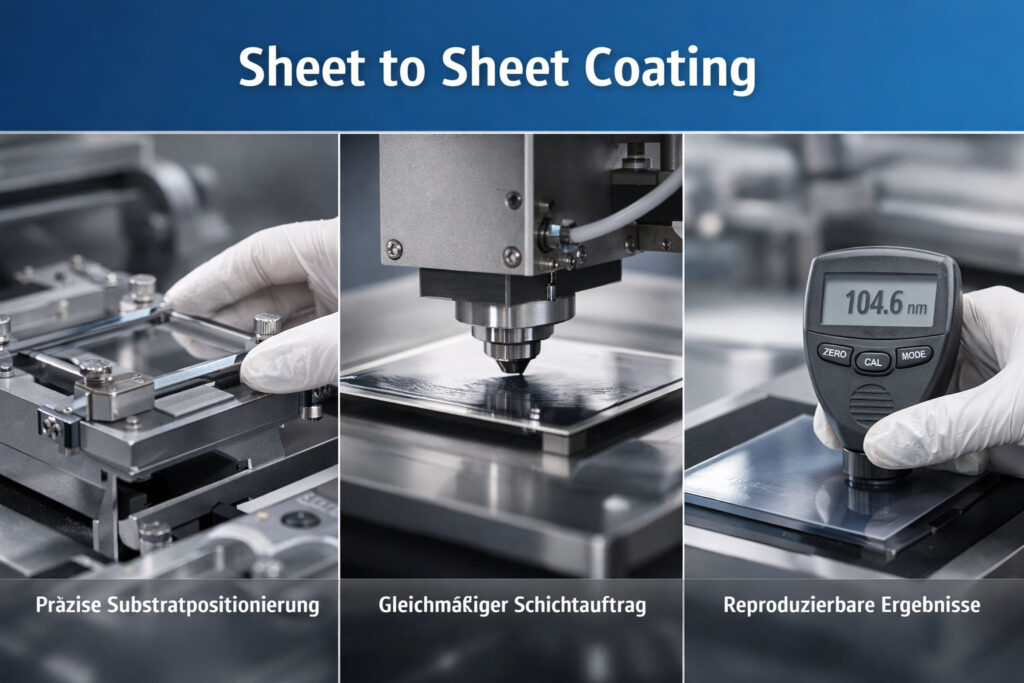
Single-sheet coating under controlled conditions means that each coating step is reproducible and independent of external influences. A key requirement for this is precisely defined substrate positioning combined with stable mechanical process control. Only if the position, flatness, and fixation of the substrate remain constant can a homogeneous layer with uniform thickness form.
Furthermore, controlled material application plays a crucial role. Material quantity, application speed, and coating distance must be precisely coordinated to achieve comparable results across multiple substrates. A controlled, substrate-by-substrate coating process thus provides the foundation for robust test series, clear process windows, and the reliable further development of functional coatings.
Typical applications of sheet-to-sheet coating
Sheet-to-sheet coating is frequently used in research and industrial development environments where individual substrates need to be coated with high precision. The discontinuous process allows for a detailed analysis of layer properties and process parameters.
Discontinuous coating is particularly relevant.
This is particularly useful in applications where rigid substrates are processed or flexible adjustments to process parameters are required. Treating the substrates individually allows for clear differentiation and documentation of experiments.
Typical applications include the development of functional thin films, electronic applications, and specialized functional coatings. In all these areas, sheet-to-sheet coating enables high process control and reproducible results.
Thin-film development
sheet-wise coating
It is ideally suited for the development of functional thin films, as individual substrates can be precisely coated and systematically evaluated.
Research and laboratory applications
In research, the discontinuous approach a targeted variation of process parameters and a clear assignment of effects to individual coatings.
Electronic components
Rigid substrates such as glass or ceramics can be coated with high accuracy, which is crucial for reproducible electrical properties.
Prototype and small series production
Sheet-to-sheet coating allows for flexible and controlled production of small quantities without the effort of continuous processes.
Functional and protective coatings
Coatings for the targeted adjustment of mechanical, chemical or optical properties can be reproducibly applied to individual substrates.
Pilot and pre-series processes
The process serves as a bridge between laboratory development and industrial implementation, as stable process windows can be defined and documented.
Structured solutions for precise sheet coatingen
Coatinggap follows a clearly structured approach to sheet-by-sheet coating, focusing on precision, reproducibility, and process understanding. Discontinuous coating processes require a particularly robust mechanical design, as any deviation directly affects the coating quality.
Coatinggap systems enable precise positioning of the substrates, a controlled material application and reproducible process control. All relevant parameters can be clearly defined, documented, and selectively varied. This creates a stable process window, which is particularly advantageous for development and pilot applications.
Coating gap systems enable precise substrate positioning, controlled material application, and reproducible process control. All relevant parameters can be clearly defined, documented, and selectively varied. This results in a stable process window, which is particularly advantageous for development and pilot applications.
Another advantage lies in the flexibility of the systems. Sheet-to-sheet coating processes can be quickly adapted and transferred to new substrates or materials without changing the fundamental process structure. This reduces development time and increases the reliability of trials.
Structured solutions for precise single coatings are based on clearly defined process steps, stable mechanics, and reproducible parameters. When coating individual substrates, this approach enables precise control of each coating process. Substrate positioning, material application, and process control are designed to ensure comparable and reliable evaluation of results. This creates robust process windows that support the safe development of functional coatings.
From structured experimentation to robust application in Coating panels.
In sheet-to-sheet coating, a clearly structured development process is crucial for achieving reproducible and reliable results. Coatinggap supports this approach with precise systems that enable a clean separation of individual process steps. Parameters such as substrate positioning, material application, and coating distance can be precisely adjusted and systematically evaluated. This results in traceable outcomes that can be compared and further developed. The focus is on establishing processes that are not only functional but also technically manageable, creating a secure foundation for prototypes, pilot processes, or application-oriented coatings.
Sheet-to-sheet coating Build sustainably and continue in a controlled manner
Mastering coating processes begins with a deep understanding of the underlying relationships between material, mechanics, and process control. In many applications, the initial focus is on the feasibility of a coating, while the long-term stability of the process is considered later. This is precisely where uncertainties often arise. Without clearly defined parameters and reproducible conditions, results can only be compared or evaluated to a limited extent.
A structured approach therefore starts early.
Coating distances, material feed, relative movements, and substrate guidance must be consciously defined and documented from the outset. The goal is to design a process that is not only functional but also traceable. Only when the effect of individual parameters is understood can processes be specifically adapted and optimized.
Further development of coating processes is only meaningful if sufficient process stability is ensured. Unstable conditions lead to variations that make it difficult to evaluate changes in materials or processes. Therefore, stability is not a subsequent optimization step, but a fundamental prerequisite.
Process stability This results from mechanical precision, consistent motion sequences, and controlled material application. Fluctuations in speed, position, or material quantity directly affect the coating quality. If these influences are not controlled, results cannot be reliably reproduced.
Long-term successful coating processes are characterized by the fact that they not only function at the current scale but are also prepared for future requirements. This includes the ability to adapt, expand, or scale processes without losing their stability. A well-designed process offers precisely this flexibility.
Manageable processes create planning certainty. They make it possible to develop new applications, change materials, or adjust process parameters without having to start from scratch. At the same time, they reduce development risks, as decisions are based on traceable data and reproducible results.
A reliable partner for sheet-to-sheet coating processes
Sheet-to-sheet coating demands a high degree of precision and process control. Coatinggap addresses this need directly, supporting users in establishing stable and reproducible discontinuous coating processes. Through structured process control, mechanical accuracy, and technical clarity, processes are created that are not left to chance. Coatinggap is the right choice when sheet-to-sheet coating needs to be reliable and technically manageable.