
Development for reproducible coating processes
Coating process development is key to reproducible coating processes. The goal is to design processes that do not depend on chance or individual settings, but rather deliver reliably comparable results under defined conditions. Only by systematically recording, controlling, and evaluating all relevant influencing factors can coating processes be mastered in the long term.
The focus is on understanding the relationships between material properties, process parameters, and mechanical boundary conditions. Through structured test series and clearly defined references, process windows are defined and stabilized. This results in coating processes that not only work in individual cases but are also reproducible, robust, and capable of further development – a key prerequisite for research, development, and application-oriented implementation.
Structured development as the basis for reproducible processes
Coating process development refers to the systematic design and targeted stabilization of coating processes. The goal is not only to implement processes functionally, but also to make them reproducible, comparable, and technically verifiable under controlled conditions. To this end, all relevant influencing factors are considered – from material and process parameters to... mechanical boundary conditions – structured recording and controlled management.
In practice, coating process development serves to understand, optimize, and secure processes step by step. Defined test series, clear references, and a consistent process logic allow for the reduction of variations and the targeted delimitation of process windows. This results in coating processes that are robust beyond individual tests and form a stable basis for research, development, and application-oriented implementation.
What coating process development really means
Coating process development describes the methodical design of coating processes with the goal of making them reproducible, comparable, and controllable in the long term. The focus is not on the individual result, but on understanding the relationships between material, process parameters, and mechanical boundary conditions. Only when these factors are systematically recorded and controlled can reliable processes be developed. A structured approach to coating process development means consciously defining processes, varying them in a targeted manner, and evaluating them reproducibly. Parameters such as coating deposition, process speed, and substrate handling are not considered in isolation, but rather, for example, within controlled coating procedures such as... slot die coating or doctor blade coating The interactions are analyzed. This creates clear process windows that make it possible to reliably compare and further develop results.
Building process understanding
Coating process development begins with a systematic understanding of all relevant influencing factors.
A reliable coating process requires an understanding of the relationships between material properties, process parameters, and mechanical boundary conditions. Coating process development aims to make these interactions transparent and to analyze them systematically. Structured experimental approaches allow for the identification of causes of variations and the deliberate control of process parameters, rather than leaving results to chance.
Ensure reproducibility
Reproducibility is the basis for comparability and reliable process decisions.
Coating process development aims to create identical conditions for repeated process runs. Only when processes under the same conditions lead to comparable results can developments be evaluated and optimized. Mechanical stability, defined references, and controlled process management ensure that results remain reproducible and serve as a reliable basis for decision-making.
Securing processes in the long term
Structured process development creates the basis for long-term stable coating processes.
Beyond individual trials, coating process development considers the entire life cycle of a process. This is achieved through the gradual narrowing down of Process windows And by safeguarding against fluctuations, robust processes are created. These make it possible to continue, adapt, or transfer processes to new requirements safely without jeopardizing process stability.
Structured development under controlled conditions
Control creates comparability and reliable results
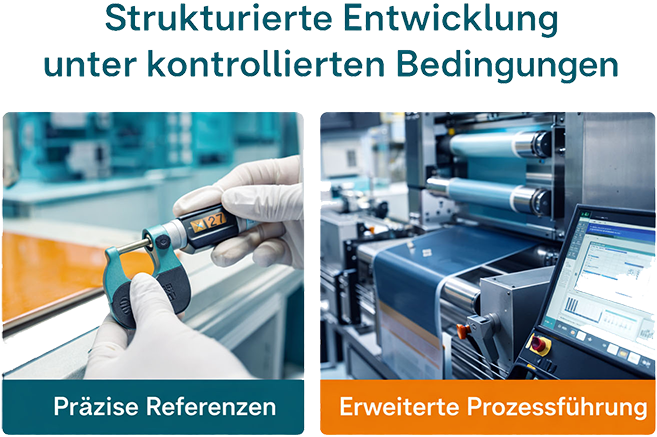
Coating process development requires clearly defined and controlled framework conditions. Only when mechanical, procedural, and material-related influencing factors are stably managed can success be achieved. mechanical influencing factors of modern coating systems
Meaningful comparison, evaluation, and targeted optimization are key. Uncontrolled boundary conditions, on the other hand, lead to variations that make a reliable interpretation of the results difficult or impossible.
Under controlled conditions, processes are not considered in isolation, but rather systematically structured. Parameters such as layer application, process speed, or substrate guidance are specifically adjusted and monitored. controlled wet-coating processes The process is varied reproducibly. This allows for a clear identification of the relationships between process control and layer properties. Coating process development thus becomes a structured tool for gradually stabilizing and securing processes in the long term – from the early development phase to application-oriented process stages.
What controlled process development requires
In order for coating processes to be set up reproducibly and further developed in a targeted manner, certain technical and methodological prerequisites must be met. These form the basis for structured process control and make it possible to compare results and ensure the long-term reliability of processes.
Coating process development as a consistent development approach
Coating process development is not a single step, but a cohesive development process. The goal is to design coating processes in such a way that they can be traced from the initial idea through structured trials to robust applications. This involves linking technical, procedural, and organizational aspects to ensure that processes are not only functional but also manageable in the long term.
A consistent development approach ensures that insights gained from early phases are not lost but can be systematically reused. Coating process development thus establishes a clear line between experimentation, optimization, and stable process control, forming the basis for reproducible results across various development stages.
Goal definition
Clear definition of the desired layer properties and process goals.
Parameter structure
Systematic recording and organization of all relevant process variables.
Experimental logic
Planned and verifiable test series instead of random individual tests.
comparability
Uniform conditions for reliable comparisons of results.
Process window
Gradual narrowing down of stable and robust work areas.
Security
Verification of process stability against fluctuations.
Continue and secure the coating process in a targeted manner.
Coating process development doesn't end with a functioning process. Only when processes remain stable even under varying conditions can they be considered robust. The goal, therefore, is not only to define coating processes but also to systematically refine, validate, and adapt them to new requirements. Insights gained during the development phase are systematically used to progressively refine processes, identify risks early on, and ensure long-term reproducibility.
A structured approach allows for reduced variation, targeted expansion of process windows, and better control of critical influencing factors. This is particularly important when... discontinuous processes such as sheet-to-sheet coating processes This highlights the importance of a stable development framework for maintaining comparable results and reliably advancing processes. Coating process development provides the foundation for long-term process reliability and controlled transfer to application-oriented process stages.
Stability as a prerequisite for sustainable process development
Sustainable coating process development requires systems that function reliably even with slight fluctuations. Mechanical precision, defined parameter control, and a clear process logic form the foundation. mechanical design of modern coating systems plays a central role, as only reproducible references and stable motion sequences allow targeted adjustments without changing the nature of the process.
As part of coating process development, process windows are therefore not only initially defined, but continuously monitored and validated. This creates a robust development framework that enables coating processes to be operated reliably in the long term, optimized in a targeted manner, and reliably adapted to new requirements.
In the long term, this creates a robust development framework that makes it possible to continue coating processes safely, scale them up, and, for example, adapt them to other applications. continuous roll-to-roll coating processes to transfer without jeopardizing process stability. Coating process development thus becomes a continuous tool for operating processes safely, optimizing them in a targeted manner, and reliably adapting them to new requirements.
Coating process development as a link between laboratory and application
Coating process development forms the interface between experimental research and application-oriented implementation. In early development phases, the focus is often on individual material investigations or feasibility studies. However, without structured process development, these results remain isolated and are difficult to utilize further. Only through the systematic translation into clearly defined process sequences can a reliable basis for further steps be created.
Coating process development as a sustainable basis for stable processes
Structure creates security, reproducibility, and long-term success.
The selection of a suitable coating system is crucial in determining how stable, reproducible, and at the same time, scalable the product will be. Coating processes long-term. Besides the process used, mechanical precision, clear references, and structured process control play a central role. Coating systems must therefore be designed not only to meet current requirements in industrial coating but also to allow for future adaptations and further developments. Only on this basis can coating processes be operated consistently and reliably secured across multiple development stages.
From analysis to a robust process basis
Coating process development aims to make coating processes not only functional but also permanently controllable. Through a
Analyzing all relevant influencing factors results in processes that can be reproducibly configured, compared, and systematically developed further. Instead of short-term optimizations, a robust process foundation is created that delivers stable results even over extended periods.
A reliable framework for future requirements
Well-developed coating processes are characterized by their adaptability to changes and their flexibility in not relying on rigid constraints. New materials, adjusted target parameters, or altered process environments can be integrated within a clearly defined process framework without compromising stability or reproducibility. This requires a thorough understanding of the relevant influencing factors and their interactions throughout the entire coating process.
Coating process development creates precisely this foundation by not only optimizing the coating to a defined target state, but also evaluating its robustness and ensuring its long-term reliability. This allows for adjustments in the industrial coating Changes can be made in a controlled manner without having to fundamentally redesign the process. In the long term, this approach makes it possible not only to operate coating processes successfully today, but also to continuously develop them, refine them in a targeted manner, and reliably adapt them to future requirements – regardless of whether materials, applications, or framework conditions change.
Talk to us about your coating process development
Describe your application, your requirements, and your objectives. We will support you in the structured development and validation of your coating processes and get back to you promptly with expert feedback.