
What technically distinguishes membrane coating
Membrane coating encompasses coating and casting processes in which porous or dense membrane layers are selectively built up. The focus is on uniform material distribution, controlled layer formation, and reproducible pore and functional structures. Even slight variations in the process can affect the membrane's permeability, selectivity, or mechanical stability. Therefore, membrane coating is closely linked to structured process control, in which material properties, application methods, and drying conditions are systematically coordinated. Coating plants This creates the technical prerequisites to develop stable membrane processes and evaluate them in a comparable manner.
Membrane coating as part of holistic coating processes
In practice, membrane coating is not an isolated step, but rather part of a larger process. coating process. Material formulation, substrate selection, application methods, and post-treatment directly influence the resulting membrane properties. A holistic approach makes it possible to address functional requirements specifically and to clearly define process windows. At the same time, this approach forms the basis for systematically comparing different coating processes – a crucial step for selecting suitable methods in membrane development, which will be examined in more detail in the next section.
Processes in membrane coating and casting
Key application areas of coating technology
Doctor Blade Coating
Flexible thin-film development with variable layer thickness
Doctor Blade Coating is one of the most frequently used methods in early thin-film development. The material is applied evenly to the substrate through a defined gap. This method is particularly suitable for screening experiments investigating material formulations, layer thicknesses, and drying behavior. The easily adjustable coating gap allows for rapid parameter variation and comparison. Especially in material development, this method offers Doctor blade coating a high degree of flexibility to efficiently optimize functional layers and identify initial process windows.
Slot-Die Coating
Pre-dosed coating process for maximum reproducibility
Slot-die coating is a pre-metered process particularly well-suited for precise and reproducible thin-film coatings. Unlike open processes, material deposition is controlled via a closed nozzle, minimizing material loss. This method allows for precise adjustment of the layer thickness by controlling the flow rate and coating speed. Slot-die coating is frequently used when processes are already well-developed and greater scalability to pilot or production scale is desired. It thus forms an important bridge between laboratory development and scale-up.
Roll-to-roll coating
Continuous thin-film coating for scalable processes
Roll-to-roll coating is used when thin-film processes need to be transferred to flexible substrates and processed continuously. This method enables high throughput with consistent process quality and is particularly relevant for industrial applications. In development, roll-to-roll coating serves to investigate process stability over extended run times and to evaluate scaling effects early on. Aspects such as web guidance, drying, and layer uniformity are key considerations. Roll-to-roll coating thus represents the transition from discrete development processes to industrially relevant coating solutions.
Application areas of thin-film coating
Functional layers for research, development and industrial processes
Thin-film coating is used wherever material properties need to be specifically adjusted and reliably reproduced.
Depending on the application and substrate, the requirements for layer thickness, homogeneity, and process control vary considerably. In addition to continuous processes, discrete processes such as... Sheet-to-sheet coating thin-film coatings play an important role, particularly in research and with smaller substrate formats. At the same time, they form a key basis for demanding applications. industrial coating applications, where process stability and transferability are crucial.
Thin-film coating for complex material systems
As the functional complexity of materials increases, so do the demands placed on thin-film coatings. Modern applications require precisely defined layer thicknesses, homogeneous material distributions, and stable interfaces between the substrate and the functional layer.
Especially in research and process development, it is crucial to investigate material systems reproducibly under controlled conditions. Thin-film coating makes it possible to apply sensitive materials in a targeted manner, to systematically vary process parameters, and to visualize interactions between material, solvent, and substrate. This leads to a deep understanding of the process, which is necessary for reliably evaluating new materials and for soundly preparing subsequent scaling steps – regardless of whether the focus is on energy applications, membranes, or functional surfaces.
Material formulations
The composition of solutions, dispersions or inks significantly determines the resulting layer properties and coating behavior.
Interfaces & Adhesion
A stable bond between the thin film and the substrate is crucial for mechanical, electrical, and chemical functionality.
Layer thickness control
Precisely adjustable layer thicknesses enable reproducible results and comparable material evaluations.
Drying & Curing
Evaporation and curing processes significantly influence the microstructure, porosity, and function of the thin film.
Process window
Defining stable process areas reduces variations and forms the basis for robust development processes.
Scaling preparation
Parameters relevant for later pilot or production processes are identified as early as the initial development phases.
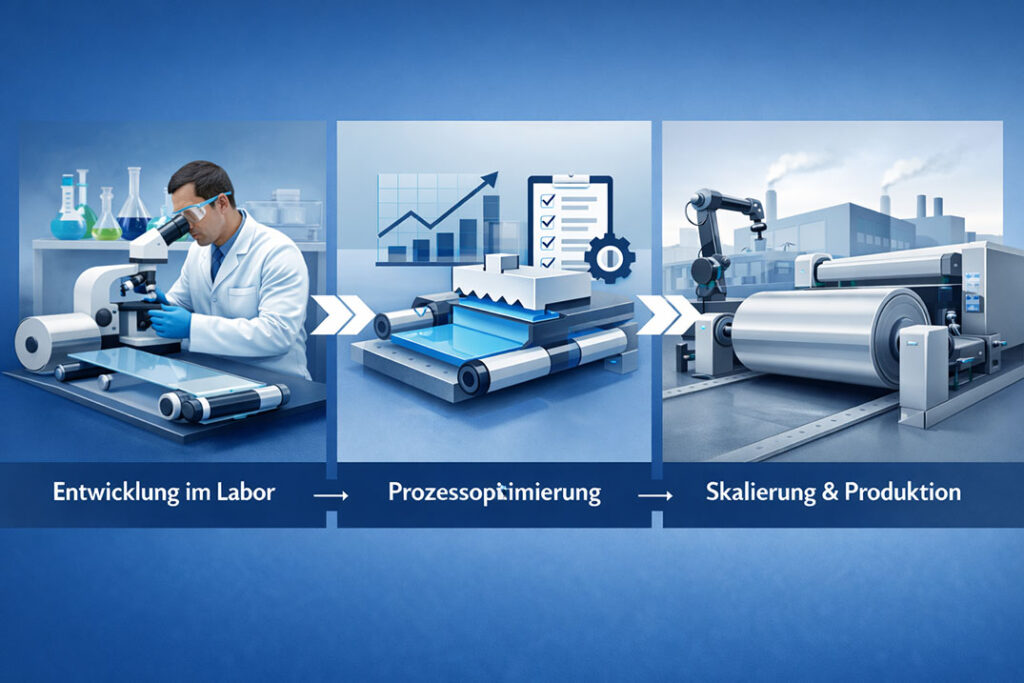
From thin-film development to scaling
Transferring a developed thin film to scalable processes is a crucial step. While parameters can be flexibly varied on a laboratory scale, the demands on process stability and reproducibility increase with larger substrates. A structured scaling strategy ensures that functional properties are maintained and results remain comparable across different process stages.
Scaling as a controlled development step
Scaling does not necessarily mean immediate industrialization, but rather the targeted expansion of existing process windows. Methods such as... Slot die coating This enables pre-dosed, uniform application, thus offering high transferability of laboratory tests to larger substrate widths. By systematically adjusting the flow rate, coating speed, and drying parameters, thin-film processes can be stabilized without altering the fundamental material properties. In this way, scaling remains a controlled part of the development process and does not disrupt the understanding of the process.
Thin-film coating as the basis for functional layer systems
Thin-film coatings form the basis for functional layer systems in which material properties are specifically tailored and combined. Instead of single, isolated layers, the focus is increasingly on multilayer structures that perform electrical, optical, or chemical functions. Controlled process management is crucial for creating stable interfaces and achieving reproducible results. The development of such Thin-film coating / Functional layers requires a deep understanding of material, process parameters and interactions between the individual layers – both in the laboratory and in further development stages.
From idea to manageable process solution
Thin-film coating with system and process understanding
A successful thin-film coating is not achieved through isolated experiments, but through a structured interplay of material, method, and process control. Crucially, development steps must remain traceable and results must be reliably reproduced. This is precisely where Coatinggap comes in: as a specialized coating company, which does not view thin-film processes in isolation, but understands them as an integrated component of functional layer systems. This creates robust development foundations that can be clearly documented, compared, and further developed.
Structure instead of chance in process development
Especially with complex material systems, a clear process logic determines whether results are usable. A well-structured approach reduces variations, accelerates development cycles, and creates the basis for informed decisions – from the initial laboratory test to further scaling.
What characterizes a clean thin-film development
These aspects together form the foundation of a successful thin-film coating. They ensure that development work doesn't get bogged down in experimentation, but rather culminates in clear, usable processes. Anyone wanting to develop thin-film systems in a targeted manner therefore needs not only suitable methods, but above all a structured approach that combines technical precision and process understanding. This is precisely where the decisive added value for sustainable development and reliable scaling arises.
Let's talk about your thin-film coating.
Whether it's an initial material idea, ongoing development, or a specific process question – direct communication brings clarity. Describe your application and your requirements to us. Together, we'll examine how your thin-film coating can be further developed in a structured, reproducible, and targeted manner.